Download Free Vegetable Growing Guide PDF (opens in a new tab)
Growing Charentais Melon in the Vegetable Garden
Charentais melon seeds should be sown at a depth of 0.5 inches. If you are directly sowing the seeds into your garden, waiting until all danger of frost has passed and the soil temperature has warmed to at least 70 F is essential. These melons prefer warm soil, so if you live in a cooler climate, you may want to start the seeds indoors and transplant them after they’ve grown. If you start your seeds indoors, harden off the seedlings before transplanting them into the garden. If growing in containers, use one that can hold at least 5 gallons of soil.
For direct sowing, space the seeds about 24 inches apart in rows spaced 6 feet apart, as the vines will need plenty of room to spread. You can also opt for hill planting, which involves sowing 3-4 seeds per hill, spaced about 3 feet apart, with 5-6 feet between each hill. Once the seedlings have emerged and are a few inches tall, thin them out to the strongest seedling per hill.
Charentais melons are heavy feeders and require rich, well-drained soil. Before planting, amend the soil with plenty of organic matter, such as compost or well-rotted manure. When the plants start to vine, give them a balanced fertilizer like 10-10-10 to promote healthy growth. Avoid excess nitrogen, as this can result in lush foliage but fewer fruits.
Keep the soil consistently moist but not waterlogged, aiming for about 1 to 2 inches of water per week. Use a drip irrigation system or water at the base of the plant to avoid wetting the foliage, which can lead to fungal diseases. Be careful not to overwater once the fruits start maturing. If grown vertically, training the vines along trellises or supports can improve air circulation and make harvesting easier. In areas with few pollinators, you may need to hand-pollinate your melon flowers to ensure fruit set.
Harvesting Charentais Melon
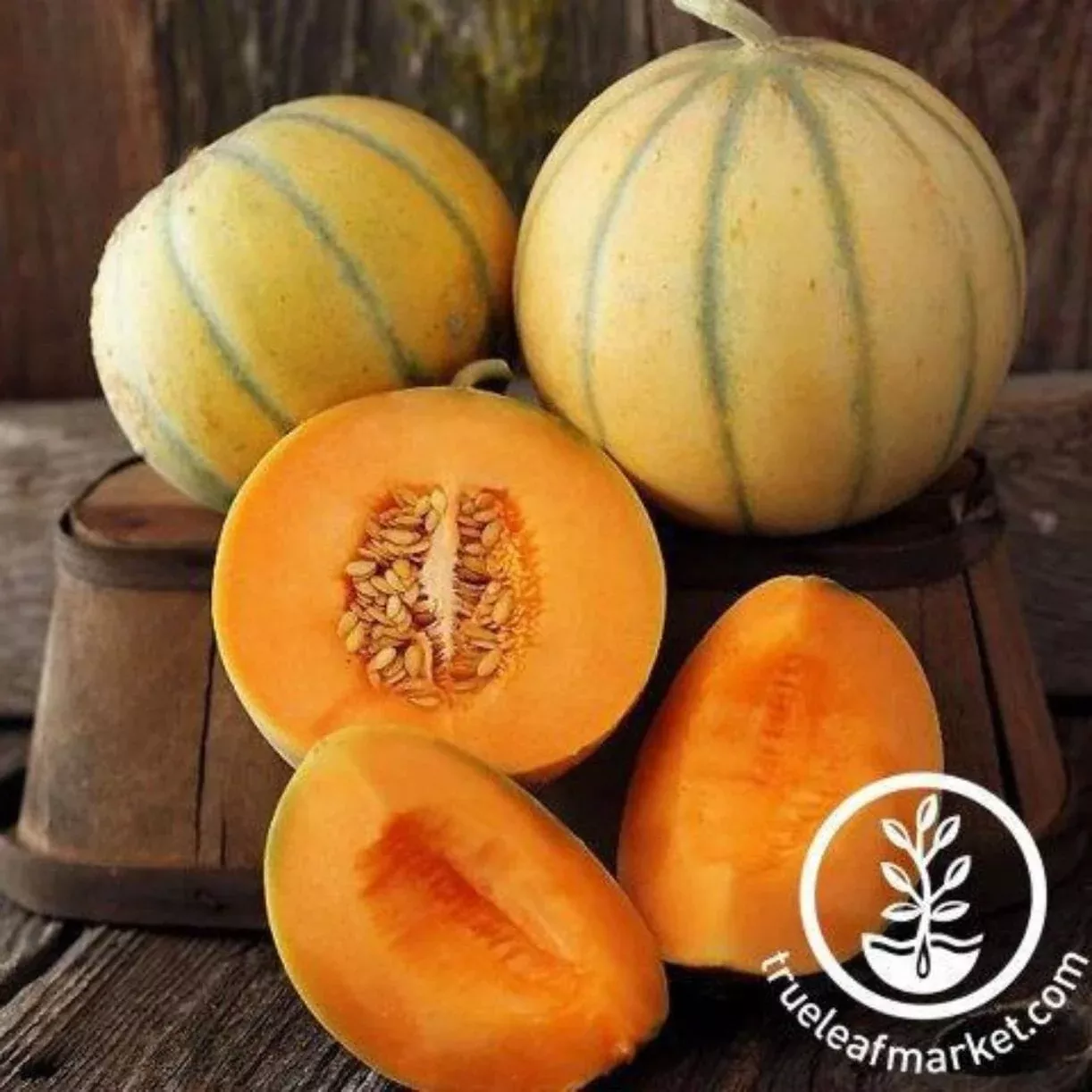
You’ll know the melons are ready when they emit a strong, sweet fragrance, the rind color changes from green to golden-yellow, and the fruit easily slips off the vine with a gentle tug. To harvest, simply twist or snip the melon from the vine. Avoid pulling or yanking the fruit off. Handle with care.
About Charentais Melon Garden Seeds
An heirloom variety dating back to France in the 1920s, this Charentais melon was bred in the Poitou-Charentes region (hence the name). Originally developed for the French market, this melon was bred for its exceptional flavor and small size, which makes it perfect for individual servings.
It quickly gained a reputation as a gourmet fruit, beloved for its intensely sweet, aromatic flesh and smooth texture. It’s often associated with the town of Cavaillon, where it is celebrated as a local delicacy.
Mother Earth News says, “Among many delicious melons that are too fragile to ship, the French cantaloupes are at the top of my list. Perfectly sized for a half-melon serving, the French Charentais types have thick, firm, orange flesh and a small seed cavity.”
In her book Melons for the Passionate Grower, Amy Goldman writes, “It is a refined cantaloupe… free of the blemishes and warts of its ancestors.”
Tips From Our Gardeners
“Charentais melons are best enjoyed soon after harvest. They do not store, ship, or transport well. These melons are ideal for home gardeners who want to enjoy a piece of French culinary history in their backyard.”